


Primer Selection Mastery: Matching Pre-coat to Substrate for Flawless Adhesion
In Hp Indigo Liquid ElectroPhotography, the primer layer is the invisible foundation of every print. Choose wrong and you get ink peel, poor die-cut performance, and color washout. Choose right — and your prints survive the label applicator, the freezer, and the supply chain.
Ask any experienced HP Indigo operator what causes the most inconsistent print quality, and "primer mismatch" will appear near the top of the list. The primer — or pre-coat — is a thin chemical coating applied to the substrate before the ink reaches it. Its job is to modify the substrate surface energy so that Electroink particles can anchor, flow, and cure correctly.
Different substrates — paper, BOPP film, PET, aluminum foil — have radically different surface energies. A primer formulated for coated paper will fail completely on untreated BOPP. Yet many print shops still keep a single "universal" primer on the shelf and hope for the best. This article explains why that strategy fails, and how to build a primer selection protocol that matches chemistry to substrate every time.
The HP Indigo LEP process transfers a ~1-micron ink film from the heated blanket to the substrate. For that film to adhere permanently, the substrate surface must be chemically receptive. Paper substrates — especially coated papers — usually are. Films like BOPP and PET almost never are. Without a primer, the ink film sits on the surface like water on wax: it may look fine initially, but any mechanical stress — folding, abrasion, temperature change — causes it to peel or flake.
A quality primer does three things simultaneously: it raises the surface energy of the substrate to a level where ElectroInk can wet out and bond; it creates a micro-porous anchor layer for the ink film; and it maintains dimensional stability so the ink does not crack during post-press operations like die-cutting or folding.
| The Five Substrate Families — and Their Primer Needs | |||
| Substrate Family | Surface Energy (dyn/cm) | Primer Type Needed | Key Failure Mode |
| Coated Paper | 38–42 | Standard paper primer | Ink bleed on uncoated edges |
| Uncoated Paper | 32–38 | Penetrating primer (fast-set) | Ink absorption → muted colors |
| BOPP Film (untreated) | 30–32 | Film adhesion primer (BOPP-specific) | Catastrophic ink peel on application |
| PET Film | 34–38 (treated) | Polyester-compatible primer | Edge lift on curved surfaces |
| Aluminum Foil | N/A (metallic) | Metal adhesion primer | Oxidation-related adhesion loss |
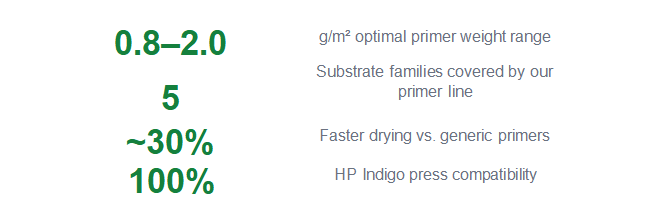
More primer is not better. Over-priming is a common mistake that leads to two problems: extended drying time (slowing press speed) and "orange peel" texture in solid ink areas. The correct primer weight depends on the substrate, but a good rule of thumb is 0.8–1.5 g/m² for paper and 1.2–2.0 g/m² for films.
INDIGO Electroink primers are formulated with a narrow viscosity window that allows consistent spray or roller application without adjustment between jobs. This is a significant advantage over generic alternatives, which often require viscosity correction (adding solvent or water) to achieve the same transfer efficiency. In a production environment, that correction step is where consistency breaks down — different operators make different judgments, and primer weight drifts.
Every substrate-primer combination should be validated before a production run. The industry-standard "tape test" — applying and rapidly removing pressure-sensitive tape over a solid ink area — is a good first screen, but it misses failures that appear after 24–48 hours (post-cure adhesion). A more thorough protocol includes:
INDIGO Electroink provides a printed Substrate Compatibility Chart with every primer shipment, listing validated combinations for all major substrate brands available in LATAM markets. If your substrate is not on the chart, send us a sample and we will run the adhesion test suite and recommend the correct primer formulation.
Five formulations covering the full substrate spectrum: Paper Standard · Paper Uncoated · BOPP Film · PET Film · Metal/Foil. All validated on HP Indigo 6K/8K/25K/35K/200K presses. Available in 1L, 5L, and 20L containers with express shipping across LATAM.
Primer Switching: The most expensive primer mistake is changing formulation mid-production without cleaning the system. Cross-contamination between primer chemistries can cause streaking, inconsistent surface tension, and adhesion failures that are difficult to trace. The solution: dedicate a primer line to film substrates, or flush the system thoroughly when switching.
A second mistake is ignoring primer shelf life. Like all engineered chemical formulations, primers have a finite shelf life — typically 12–18 months from manufacture. Using expired primer is a false economy: the surface energy modifiers degrade, and adhesion performance becomes unpredictable. INDIGO Electroink prints manufacture date and batch number on every container, and our LATAM distribution network operates on a first-expiry-first-out protocol to minimize the risk of expired stock reaching your press.
For most LATAM label converters, a two-primer system is sufficient: one paper-grade primer and one BOPP/film primer cover approximately 80 percent of jobs. As you move into flexible packaging and specialty films, add PET and metal primers to the rack. The cost of carrying multiple primers is small compared to the cost of a single adhesion failure on a high-value flexible packaging run.
INDIGO Electroink offers a Primer Starter Kit — one 5L container of each of our five primer formulations, plus substrate test strips and our adhesion test protocol — at a special introductory price for first-time customers. It is the fastest way to eliminate primer-related print failures from your operation.