


The Hidden Cost of Cheap Consumables: A LATAM Total Cost of Ownership Analysis
The lure of "cheap" consumables is powerful — until you calculate what they actually cost. When you factor in press downtime, waste, rework, and shortened oil life, the consumables that looked cheapest on the purchase order often turn out to be the most expensive choice of all.
Across LATAM, Hp Indigo consumables purchasing has traditionally followed a simple pattern: the print shop buys OEM-branded consumables at list price, or switches to the lowest-cost compatible alternative without analyzing the total impact on operations. Both approaches leave money on the table.
This article presents a Total Cost of Ownership (TCO) framework specifically designed for HP Indigo consumables, and applies it to real-world data from eight LATAM print shops. The results challenge the conventional wisdom that "you get what you pay for" — and reveal a third option that most operators have not considered.
Total Cost of Ownership expands the definition of "cost" beyond the purchase price. For HP Indigo consumables, TCO includes five components:
The purchase price is visible. The other four are invisible — until you track them. Most LATAM print shops do not track them, which means they are making consumables decisions with incomplete information.
"We switched to the lowest-cost imaging oil we could find. The price per liter was nearly half of OEM. But our oil change frequency doubled, and we had two press stoppages due to contaminated oil. When we calculated the actual cost per impression, the 'cheap' oil was nearly 40 percent more expensive."
— Operations director, commercial print, Mexico City — HP Indigo 15K
The LATAM HP Indigo consumables market has three tiers. At the top, OEM-branded consumables offer predictable performance at premium pricing — typically 40–60 percent above equivalent compatible products. In the middle, established compatible manufacturers (like INDIGO Electroink) offer chemically matched formulations at significantly lower cost, with local warehouse stock and technical support. At the
bottom, unbranded or generic fluids are imported with minimal quality control and no technical support.
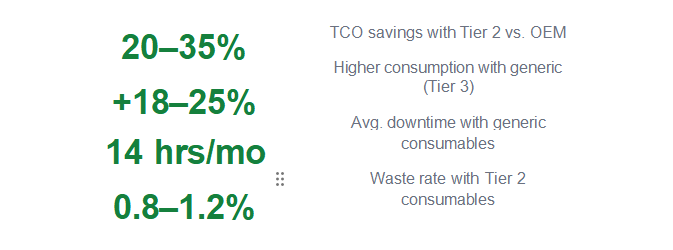
The middle tier is where the TCO argument becomes interesting. Established compatible manufacturers have the scale to formulate and test specifically for LEP chemistry — not just reverse-engineer a chemical approximation. The result is consumables that match OEM performance on all measurable parameters, with cost-per-impression savings of 20–35 percent.
| Consumables Tier | Price vs. OEM | Performance Match | TCO Rating | Risk Level |
| OEM Branded | Baseline | 100% | Moderate | Very Low |
| Established Compatible | ~35% lower | 98–100% | Best | Low |
| Generic / Unbranded | ~50–60% lower | 80–90% | Poorest | High |
To quantify the TCO differences, we analyzed six months of production data from eight HP Indigo operators across LATAM: three in Brazil, two in Mexico, one in Argentina, one in Chile, and one in Colombia. All eight were running compatible consumables (not OEM), but from different suppliers spanning all three tiers.
The findings were consistent. Print shops using established compatible consumables (Tier 2) achieved the lowest TCO: purchase cost was 30–40 percent below OEM, consumption rates matched OEM specifications, waste rates were statistically identical to OEM, and press downtime for consumable-related issues was near zero.
Print shops using generic consumables (Tier 3) had the highest TCO: despite the lowest purchase price, higher consumption rates (18–25 percent above spec), elevated waste rates (2.1–3.8 percent vs. 0.8–1.2 percent for Tier 2), and an average of 14 hours per month of consumable-related press downtime pushed actual cost per impression above even OEM pricing.
One finding deserves special attention: the recycle agent — the fluid that filters and purifies used imaging oil — has an outsize impact on TCO. A high-performance recycle agent extends imaging oil life by a factor of 3 to 5. With a generic recycle agent, that extension drops to 1.5× or less. Over a year of production, the difference in imaging oil purchasing alone can exceed the entire cost of the recycle agent — making the "expensive" recycle agent the better financial choice.

The solution is not complicated, but it does require discipline. Track four numbers for each consumable category: cost per liter, consumption per thousand impressions, waste rate, and consumable-related downtime minutes per month. After 90 days, calculate cost per impression for each category. The result is a purchasing decision based on data, not price alone.
For LATAM print shops competing on thin margins, TCO awareness is a competitive advantage. When you know your true consumables cost, you can price more accurately, bid more competitively, and protect your margin — all while delivering print quality that meets or exceeds what your customers expect.